I like to visit European cathedrals, basilicas and such-like for the art and architecture but they are also great studies in social order and in particular, the projection of power. Here are some recent notes:
One, Bergamo, in the foothills of the Italian Alps, near Milan. There's a cathedral here, the Duomo di Bergamo, a presentable if not electrifying pile, with a somewhat forgettable Tiepolo in he apse. But what makes it interesting is that right cheek by jowl is another church--Santa Maria Maggiore, which you could easily mistake for the Cathedral, were it not that the Cathedral is right next door. I really didn't get the story straight. One remembers the old joke about "that's the church whose doorstep I will not cross, so help me God!" But I get the impression that the explanation here may be even simpler than that: some sort of town-down dustup, in permanent truce, never quite resolved. The fun part is that the "other" church, though not a Cathedral, does seem to have some sort of "bishop's door" in the (east?) wall. The catch is that it appears to be 16 feet off the ground, with no stairway. One can only wonder how many bishops they lost before they figured that one out.
[Bergamo, by the way, is the birthplace and last resting place of Gaetano Donizetti. But if the Verdi industry is all over Verdi's natal turf, the Donizetti industry is almost nonexistent. On the other hand, I suppose going home to die crazed with syphilis at the age of 50 is not exactly what the guys down in publicity were hoping for.]
But more about churches: St Petersburg, i.e., Russia, where I note three. There is first of all St. Isaac's Cathedral, right there in tourist central, just down the street from the Hermitage. It's not exactly awful but it is a grey, gloomy lowering 19th-Century hulk that seems capable of sucking the fun out of any party (back in the 70s, I climbed the steps to the observation deck and greeted the 16-stone babushka whose job was to stand up there all day--in any weather, I assume--to warn you not to take pictures of the navy yard across the river).
Second, Kazan Cathedral, not that many blocks down Nevsky Prospect (and why does one city get two cathedrals?). It is even larger than St Isaac's and, if anything, even more grey and menacing--these Russian autocrats didn't want you to think of churches as having anything to do with fun.
But third and most interesting, just a short way from the Kazan Cathedral, is the Church of Our Savior on the Spilled Blood, and this one is the one that looks most like what a tourist would expect: onion domes and bright colors. You could easily take it for an ancient foundation but no: work was begun in 1883 and completed only in 19o7. Another oddity: it seems to have been built in the middle of the street, or canal or both.
What's going on here? The answer is that it was built on the very spot (so they say) where Tsar Alexander II was assassinated in 1881. So: it was commissioned almost immediately after the assassination, under an injunction that the architects stick to a traditional Russian design. The dynasty, of course, stayed in power until 1917, and if that isn't church isn't a projection of power, why I don't know.
[It languished, of course, in Soviet times, but later went through a massive overhaul; it was reopenened again in 1997. The walls are covered with mosaics that are, granted, marvels of craftsmanship, although the pictures end up looking a lot like the ones in my Classics Comics when I was a kid.]
Showing posts with label Italy 2010. Show all posts
Showing posts with label Italy 2010. Show all posts
Sunday, June 20, 2010


Monday, May 31, 2010
Turin, Who Would have Guessed?
 Turin: it's nowhere, and it is history, famous for the Savoy dynasty who departed in the 1860s, and for the Fiat plants--the Detroit of Italy. But surprise: it is a pleasant, easy-going city, with some remarkable baroque architecture, good food and a drop-dead view of snow-capped Alps. Not a destination stop, maybe, but (at least with a bit of opera) a perfectly pleasant place to spend a couple of days. They've even got the shroud of Turin, which they brought out for the Pope, although not for us; we had to settle for the Virgin Mary on a cruller.
One thing I don't understand: how it is that Italian cities sustain so many bookshops, with so many books, and in so many languages. Of course I don't think of these people as ignorant in any sense, but it's hard to manage anybody achieving the level of obsessive reading that would seem to be necessary to sustain all that print stuff.
The architecture in Turin is great if you like that kind of stuff, although it may be a special taste; among other things, I suspect they have more heroes on horseback than any other city their size (or bigger). The Chiesa Reale, where they (claim to house) the shroud is also a model of baroque
There is one piece of unambiguous awfulness: a tall skinny red-brick Mussolini tower (above), built (so they say) on purpose to overawe the Savoy Palace. Brings to mind the old joke which holds (remodeled) that the best place to live is in the Mussolini tower because that's the one place from which you cannot see the Mussolini tower. I talked to a local who said some people were sorry the Allies didn't blow it to kingdom come, but he was glad that it was still here, so as to remind the Torinese of what a mistake they'd made.
Food:top marks to Paficco Defillipis in Via LaGrange, hand-maker (it says here) of pasta since 1872. But somebody in the family seems to have discovered the slow foods movement and they turn out lovely veggies and semi-dried meats.
Sunday, May 30, 2010
Opers Note: La Bohème in Turin
Having disparaged Wagner, I have to admit I am not that nuts about Puccini either.* But after an evening of Das Rheingold, I'd have to say that there is nothing more refreshing than an afternoon of La Bohème, particularly so in the company of the good folks of Turin at the Teatro Regio. It's a diverting venue in its own right, modern in so many ways that La Scala and La Fenice are not (indeed, I suspect you could pack both La Scala and La Fenice into Teatro Regio and still have seats left over. For they fielded an all-round heavyweight cast, leading off with Marcelo Álvarez as Rodolfo (although my friend Joe points out that he skipped the high Cs). Barbara Frittoli might seem just a bit just too poised and restrained to play the great consumptive Mimi (it was her debut role at Naples 18 years ago). But she has such a lovely voice you forgive her a lot. Gianandrea Noseda let his orchestra play a bit on the noisy side, although Puccini is noisy to begin with and things might have sounded better on the ground floor than it did up in the box were we sat. Still, it was a perfect example of Italian mellow: a cheerful audience digesting a good lunch or looking forward to a good dinner on a bright spring day and an old warhorse that it is almost impossible to get wrong.
Fn,: My attention is called to the fact that La Bohème had its premier here back in 1896, conducted by the young Arturo Toscanini. Different theatre, though. Allies bombed the old one in WWII.
===
*Well, is there anything you do like? Yes, quite a bit. Mozart, a lot of Verdi, a good bit of Handel, most Strauss. And Gianni Schicchi, and the second act of Tosca.
Opera Note: La Scala Das Rheingold
In the realm of opera, I generally do Wagner only if it is a condition of my parole, but we got a chance to see Daniel Barenboim conduct Das Rheingold at La Scala last night and I figured this was an opportunity I shouldn't pass up. As it happens, we hit it at a dramatic moment. As the curtain rose, we encountered not swimming nymphs but a gaggle of (I guess) stage hands in their everyday combat togs with a banner saying
That is: no to the decree (?); yes to music, yes to culture. Somebody then read us some kind of manifesto denouncing a (n as it appeared) recent funding cut. Actually, two people--a man read it in Italian, then a woman in English. You might think they were greeted with an outpouring of labor solidarity, but recall this is Italy and if there is one thing they love better than work stoppage it is opera. Strike that: booing at the opera, or specifically at this gaggle of agitators who stood between them and their Wagner fix.
Oh, yes, the opera. Ah, let's put it this way: Barenboim is a wonder. Everything about the orchestra was crisp, disciplined, forceful, expressive (though loud, but that is not really DB's fault). The singing seemed fine although I'm not really competent to judge. Friend more competent than I said that Barenboim finds a natural ally in René Pape, who sang Wotan.
Staging seemed remarkably restrained for Wagner (I should think you would want it to be, considering how much you'd have to pay for a cast): a lot of projector visuals, chiefly what appeared to be a worked-out Kentucky coal mine:I assume this passes for heaven in some circles. There were dancers; the dancers got roundly booed, more, I think, for there mere presence than for the quality of their work. My thought was hey, at least they weren't singing.
Which brings us back to the opera itself, and to Wagner, and I swear I just do not grt it. I'll grant a fecundity of musical ideas--the notorious leitmotifs. But a lot of them are just not that interesting. And sorting out leitmotifs becomes a kind of obsessive game, like sudoku. And I barely want to speak of the plot. Recall that when all is said and done, this is an opera about a guy who tries to sell his sister-in-law to a couple of building contractors. For my money that is a plot fit for Married with Children. Yes: Sudoku and Married with Children, what a pair.
Afterthought: Forget about the decreto, this is a time when governments all over Europe are talking about painful budget cuts ("lacrime e sangue," said one Italian paper, tears and blood). Even though it won't be more than a gnat's eyebrow, I should think that the (sometimes lavish) European opera subsidies will have to be one item on the block.
NO AL DECRETO
SI ALLA MUSICA
SI ALLA CULTURA
That is: no to the decree (?); yes to music, yes to culture. Somebody then read us some kind of manifesto denouncing a (n as it appeared) recent funding cut. Actually, two people--a man read it in Italian, then a woman in English. You might think they were greeted with an outpouring of labor solidarity, but recall this is Italy and if there is one thing they love better than work stoppage it is opera. Strike that: booing at the opera, or specifically at this gaggle of agitators who stood between them and their Wagner fix.
Oh, yes, the opera. Ah, let's put it this way: Barenboim is a wonder. Everything about the orchestra was crisp, disciplined, forceful, expressive (though loud, but that is not really DB's fault). The singing seemed fine although I'm not really competent to judge. Friend more competent than I said that Barenboim finds a natural ally in René Pape, who sang Wotan.
Staging seemed remarkably restrained for Wagner (I should think you would want it to be, considering how much you'd have to pay for a cast): a lot of projector visuals, chiefly what appeared to be a worked-out Kentucky coal mine:I assume this passes for heaven in some circles. There were dancers; the dancers got roundly booed, more, I think, for there mere presence than for the quality of their work. My thought was hey, at least they weren't singing.
Which brings us back to the opera itself, and to Wagner, and I swear I just do not grt it. I'll grant a fecundity of musical ideas--the notorious leitmotifs. But a lot of them are just not that interesting. And sorting out leitmotifs becomes a kind of obsessive game, like sudoku. And I barely want to speak of the plot. Recall that when all is said and done, this is an opera about a guy who tries to sell his sister-in-law to a couple of building contractors. For my money that is a plot fit for Married with Children. Yes: Sudoku and Married with Children, what a pair.
Afterthought: Forget about the decreto, this is a time when governments all over Europe are talking about painful budget cuts ("lacrime e sangue," said one Italian paper, tears and blood). Even though it won't be more than a gnat's eyebrow, I should think that the (sometimes lavish) European opera subsidies will have to be one item on the block.
Thursday, May 27, 2010
Lost in Translation
At the Verdi museum, the English says that a good tenor must "be raring to go." The Italian says "aver il diable indosso." I should think a better translation would be "have the devil up his backside."
North Italian Gazeteer
Veneziani, gran' signoriThat is:
Padovini, gran' dottori
Vicenzetti, mangia gatti
Veronese, tutti matti.
Venetians, great lords.Hey, I guess that last one rhymes.
Paduans, great scholars.
Vicenzians, cat eaters.
Veronese, all crazy.
The Evolutionary Role of Ex Voto Offerings
 Verona is a lovely city, clean and energetic with a fair number of interesting archaeological monuments. But the first thing they take you to will almost certainly be "Juliet's balcony," after the great romantic heroine who never lived her nor, in fact, anyplace else. There you'll also see the wall--really two walls--full of messages--little notes penned out by countless nameless visitors and presented as entreaties to the spirit. They say the favored form of adhesive is chewing gum, so that in a short time they will all blow away, making room for the new batch.
All of which prompted me to wonder again: what, exactly, is the evolutionary function of these ex voto offerings? In this respect I don't see a dime's worth of difference between the Juliet wall in Verona and the wailing wall in Jerusalem nor letters to Santa Claus. Nor, I suppose, curse messages, where the sender writes "may my enemy be covered with honey and tied to an anthill"--and puts the document into a clay pellet or whatever. Query, is there a "Dracula wall" someplace in Transylvania?
Everybody does it, but what is the point? I mean, I can understand the function of religious feeling in a group as a kind of social glue, holding together tribes or fighting forces (religare="to bind fast"). But what is it with all these purely private utterances of impulse? At the moment, the only one I can think of is that it provides harmless employment--perhaps he only remaining source harmless of employment--for postal clerks from Juliettaville, Italia, to Santa Claus, Indiana.
By the way, at the Juliet wall, there is also a Juliet statue, where you can get your picture taken. There is also a "Club de Julietta," which seems to be a sewing shop, not the one she hits Romeo over the head with when he spends too much time with with Rosaline. It is said that if you want to get married in an aura of romance, the mayor of Verona will rent you Juliet's balcony for a mere 2,000 Euros. No word on whether they allow Elvis regalia.
Wednesday, May 26, 2010
What I Learned Today: Palladio
I'm one up on William Shakespeare, author of Romeo and Juliet. I'm in fair Verona, where he laid his scene, and he never set foot in the place. But forget that: what I learned today made its mark up the road in Vicenzia, where I lunched in the shadow of the Basilica of Palladio, most influential of all the world's architects.
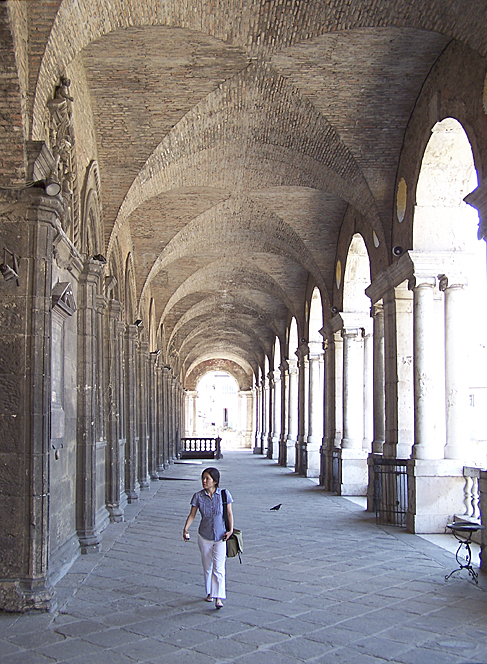
I suppose anybody who cares knew this all along but here's the deal: this Basilica is not a church. It began life as some sort of government office building. Apparent the old building fell down, or part of it, and they commissioned Palladio to build a new one. But here's the catch: they told him he had to build the new one around the old one. It's like that town in Maine that told the selectmen to build a new jail and to build it out of materials from the old jail, and not to close the old jail until the new one was finished.
So Palladio did as he was told (apparently he milked it for all it was worth--he won the contract in 1549, but it was still unfinished (and he still drawing fees) when he died 31 years later.
But here's the thing: Palladio did build the new around the old. He kept it interesting by turning the new into (per Wiki) "a loggia and a portico"-- a covered walkway lined with shop fronts. Translated: because of some silly rule imposed by the bankers, Palladio developed what must be the most standard single design for the 19th Century big-city shopping center. Here's a picture.
The moral of this story: when you've got a lemon, make lemonade.
Tuesday, May 25, 2010
Opera Note: Venetian Don Giovanni
Just a word about a performance of Mozart's Don Giovanni that we caught at La Fenice in Venice last night, and the word is: rehearsal. And I mean that in the good sense: this is a DG energetic, well-sung and (mostly) convincingly staged but it was also tightly morticed at the joints. As such it is a bracing reminder of so many major league performances you see these days, where the name star seems to have parachuted in just 20 minutes before the performance; one can only assume that he has his stage movements stenciled on the floor.
The singers were people we'd pretty much never heard of which was more testimony to our parochialism than to their skill. There was a lot of good vocal talent on display, together with some better-than-good acting. It was also a cast that knew how to work with ambiguity. Simone Alberghini's Don is a nasty piece of business who is doing it all more out of malicious amusement than for sensual pleasure. Still he has his moves, and the ladies do seem to be taken with him as they try to negotiate the treacherous void between seduction and rape. It sets you up nicely for Leonardo Cortellazzi's Don Ottavio--a skilled interpreter with a lovely voice who conveys the sad truth that he may be just a bit too nice to be interesting. It also made space for William Corrò's Musetta--the best job I've ever seen anybody do with this secondary role. He made you understand that he was basically a decent young man, not very sophisticated and a bit hot-headed, who didn't want anybody messin' with his woman.
And speaking of women--they were generally convincing although I must say this was a DG more Italian than Spanish, with plenty of effusion and more than a hint of Anna Magnini in the background. And during the "banquet" scene--here, more of an "orgy" scene--there really was more tit on display than I think I've ever seen in a major opera house before. I assume we were also getting a glimpse into the future of opera staging--not that that's a bad thing, of course. I'd save a rosette for Caterina Di Tonno as Musetta's beloved Zerlina, wide-eyed and bewildered but off on adventure not quite like anything she'd ever undergone before.
I'm not certain who deserves credit for bringing this all together so nicely but I suspect it may be Antonello Manacorda, who conducted. Whoever--he deserves credit for making a production that collected so many unforgettable numbers and wove them into a coherent whole.
This was also, as it happens, our first look at the "new" La Fenice, lately risen from the flames that kept it out of action for so many years. Or rather, the "new, old" La Fenice, insofar as it's clearly an attempt to recreate what some arsonist destroyed. Never having set foot in the old, I can't say exactly how successful they are, but I must say I do like these old European opera houses and here as elswhere, I am always surprised at how tiny they are.
Footnoe: Did I forget to mention the reserves of raw courage on display when they used real candles on stage in this monument to modern incendiarism? I assume this explains why the place was so think with Vigili di Fuoco.
Italy: Projections of Whatever
I'm still meditating on the physical/political landscape of Northern Italy and all its projections of p--I almost said "power," but that's the problem: the Italian central government has always (yes, even under Mussolini) seemed a somewhat perfunctory affair. Now that The Economist is reporting on a new spasm of second thoughts over the very principle of national unity in Italy, it's well to reflect on just how tinpot the whole business really is.
That's the ironic message that you seem to derive from all those pathetic and somewhat shrill attempts to persuade you that matters are otherwise. I'm thinking again of all those statues of Garibaldi, all those Via Cavours that I was talking about the other day. I suppose we could throw in the Via Mazzinis, the Via XX Settembres and the rest of the odd assortment of public utterances that are supposed to speak of the greatness of the Italian state. We call those sorts of things "projections of p0wer," but in Italy's case at least, they have always seemed to be projections of exactly the opposite--a painful reminder of just how lacking in real legitimacy the centralized Italian has been and today remains.
If this proposition doesn't stand on its own, then it comes home with special force here in Venice, in so many ways that most un-Italian of cities. It happens there is a statute of Garibaldi here (in the Castello, out towards the Arsenale), but I suspect nobody pays much attention to it. In general, the city seems extraordinarily free of these 19th-Century physical expressions of public authority you see so widely distributed elsewhere. The Venetians will tell you that this is because the Venetians have always been suspicious of these kinds of assertions of preeminence, and taken with a large grain of salt, this proposition harbors a grain of truth. Of all cities in the world there is probably none that operated (in its pre-themepark heyday) more is a joint stock company in which everybody had a stake and in which (as Milo Minderbinder would say) everyone has a share. There are projections of power here--the Cathedral of San Marco can hardly count as anything else. But it operates at a wholly different level of eminence and prestige. You want a real projection of power, it beats Garibaldi six ways to the jack
Monday, May 24, 2010
The Verdi Biz
I met a lady today in Italy whose name is Verdiana. Apparently in Italy there are Wagnerians and Verdians and her papa wanted everybody to know she was on the right side. It's a tiny whiff of just how much cultural apparartus still persists around here in the wake of the Great Man.
Granted, he was a first-rate talent, but that is not quite enough to explain all the stuff he left behind. I suspect it has more to do with the fact that he got his timing right: the 19th Century liked heroes, and Italy in partiularly needed a roster of great men to define its nationhood. You can only go so far with Garibaldi, and although just about every Italian city has a main drag named Via Cavour, still I suspect not one in a hundred Italians could so much as tell you who Cavour is. Verdi at least has a legitimate claim to fame.
Verdi probably did a not to nourish it himself when, after achieving fame and fortune, he moved back to his home turf at Busseto, with the intention (so it appears) of picking fights with his old friends and neighbors. They even built a pocket opera house in his name; he publicly snubbed it. As I guess I've said before, conflict is a kind of intimacy: some people just can't get enough of it.
There also, so I am told, a Verdi family, and apparently they control the paper. And I gather (though Google seems to be no help here) they too are feuding: evidently a critical player died without a will and his children have fought each other to a standstill. All I know for sure is that at the Verdi country house, nobody is mowing the lawn.
Finally, here's one I never heard of before: the Club dei 27: self-appointed self-designated keepers of the flame, one for each (so it is said) Verdi opera. All male of course (and doesn't this sound like a guy thing?). The woman (not Verdiana) who told me about it said that just the other night at the Parma opera, she sat next to Giovanna d'Arco. Evidently Stiffelio just died. I surmised that the lady who told me the story believed that she would make a fine replacement Stiffelio, but I don't think she' enjoy it: way too laddish. Maybe they need a lady's auxiliary.
Venice
To Venice, where the sky is clear, the air is cool, and where things feel unexpectedly (and uncharacteristically) clean as if a nasty rainstorm just moved through. The weather is as pleasant as I suspect you ever get it here, though still muggy enough that we may have to ration the clean laundry. I marvel once again at what must be the world's longest running and perhaps most successful historical theme-park. Consider: except for the predation of tourists, Venice hasn't had a real reason for being since the Turks took Constantinople in 1453. Yet everything we remember about Venetian art -- Titian, Tintoretto, assorted Bellinis, Tiepolo--comes later. After that, a long party, and then the more or less desperate effort to flog tee-shirts and gondola rides and generally to stay above water. Must be a great place to be a ringworm.
A gondola is going by under our window: a guy in a striped shirt is belting out "Venezia." With a karaoke machine, too much.
Sunday, May 23, 2010
Questions About Italy
If culture is a secular religion, then I guess you could say we are on pilgrimage among the shrines of Verdi country (we could paint a 747 on the outside wall of our house in Palookaville, like Egyptians do after they make the Haj). Meanwhile, two question:
One, why did Verdi move back to Busseto when he could have settled in Milan, Paris, Rome? One has to conclude (not so?) that he really enjoyed quarreling.
And two, who paid for rebuilding the cultural infrastructure of Parma? It's a projection of state power in a country that was too poor for that sort of thing. Do I smell the CIA?
Sent via BlackBerry by AT&T

Subscribe to:
Posts (Atom)